

Vector search usually sounds simple until the corpus gets large enough to hurt.
A few thousand embeddings fit anywhere. A few million start to expose the real cost of dense retrieval: RAM, rebuilds, filtered search, persistence, and the operational tax of running a vector database when all you wanted was a fast local index.
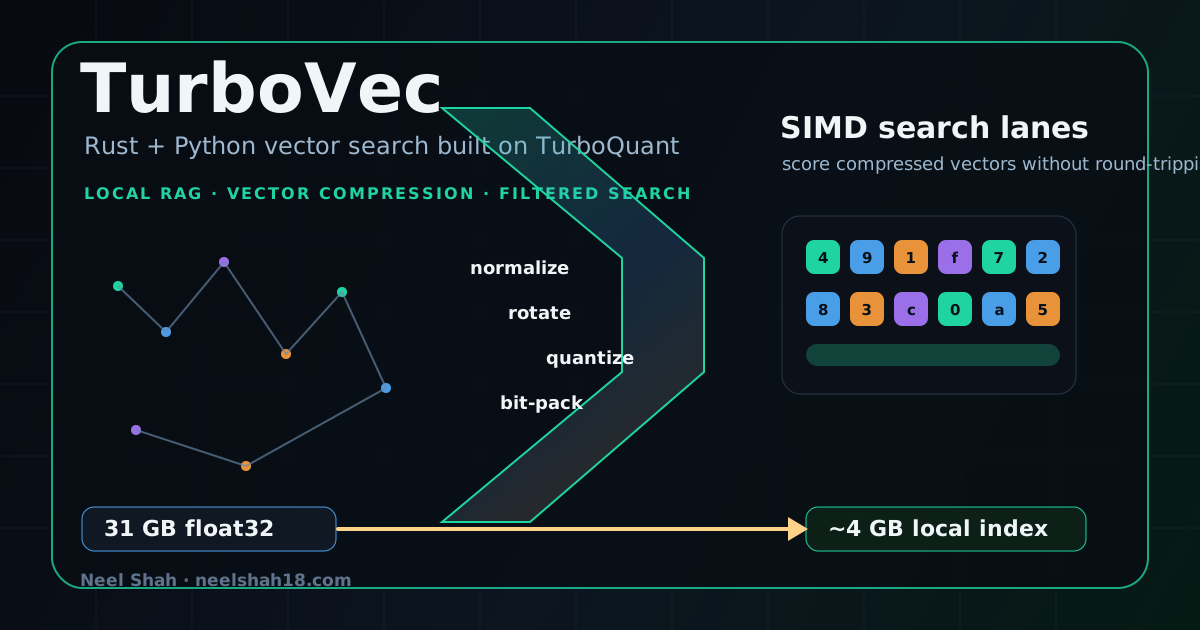
RyanCodrai/turbovec is interesting because it attacks that problem from the systems side. It is a Rust vector index with Python bindings, built on Google Research’s TurboQuant algorithm. The project headline is direct: a 10 million document corpus that takes about 31 GB as float32 can fit in about 4 GB with TurboVec, while still searching faster than FAISS in the benchmark setups shown by the repository.
That is the kind of tradeoff that matters for local RAG, private retrieval, and smaller teams that do not want every embedding workload to become a managed infrastructure project.
What TurboVec is
TurboVec is a compressed vector index.
At a high level, it lets you:
from turbovec import TurboQuantIndex

index = TurboQuantIndex(dim=1536, bit_width=4)
index.add(vectors)
scores, indices = index.search(query, k=10)

index.write("my_index.tq")
loaded = TurboQuantIndex.load("my_index.tq")
There is also an IdMapIndex for stable external IDs:
import numpy as np
from turbovec import IdMapIndex

index = IdMapIndex(dim=1536, bit_width=4)
index.add_with_ids(vectors, np.array([1001, 1002, 1003], dtype=np.uint64))

scores, ids = index.search(query, k=10)
index.remove(1002)
The shape is familiar if you have used FAISS, Annoy, HNSWLib, LanceDB, Chroma, or in-memory vector stores. Add vectors, search vectors, save the index, load it again.
The difference is the compression model. TurboVec is built around TurboQuant, a data-oblivious quantizer. It does not need to train a codebook on your dataset before indexing. You can add vectors directly, keep adding more later, and avoid a calibration step that depends on the distribution of the corpus.
For production workflows, that detail matters. Training and rebuilding are not just math problems. They are deployment events.
Why TurboQuant is different from classic product quantization
Classic product quantization usually learns codebooks from data. That can work very well, but it creates a dependency between the index and the corpus distribution. If the data changes, grows, or drifts, you may need to think about retraining, calibration quality, and how representative the training sample was.
TurboQuant takes a different route:
- Normalize vectors so each vector becomes a direction.
- Apply a random orthogonal rotation.
- Use the known coordinate distribution after rotation.
- Quantize coordinates with a precomputed scalar quantizer.
- Bit-pack the result.
- Score compressed vectors directly at search time.
The important phrase is “data-oblivious.” The quantizer is derived from the math of high-dimensional directions rather than from your dataset.
That changes the operating model:
| Classic trained quantizer | TurboQuant-style index |
|---|---|
| Needs codebook training | No codebook training |
| Calibration depends on sample quality | Quantizer does not depend on corpus sample |
| Growth can raise rebuild questions | Add vectors directly |
| Operationally heavier | Simpler local index lifecycle |
This is not magic. Compression always has a recall tradeoff. But it is a very practical design if your priority is “make the index small, local, fast, and easy to append to.”
The memory story is the obvious win
Embedding storage gets expensive quickly.
A 1536-dimensional float32 vector uses:
1536 dimensions * 4 bytes = 6144 bytes per vector
At 10 million vectors, that is roughly 61 GB for raw vectors alone. The TurboVec README uses a 10 million document corpus example at 31 GB of RAM as float32, then shows the compressed index fitting around 4 GB. The exact number depends on dimensionality, representation, and what is counted, but the engineering direction is clear: dense retrieval becomes much easier to run locally when the index is measured in single-digit gigabytes instead of tens of gigabytes.
That matters for:
- local RAG on a workstation
- private retrieval inside a VPC
- document search for regulated teams
- laptop-scale experiments that should not require a hosted vector database
- edge or air-gapped deployments
The most interesting part is not just “compression is smaller.” It is that the compressed representation is the search representation. TurboVec is not compressing for storage and then decompressing every candidate back to float32 during search.
Search speed is part of the design, not an afterthought
TurboVec uses Rust for the index implementation and exposes Python bindings for day-to-day use. That is the right split for this type of tool:
- Python is where most RAG pipelines, embedding workflows, and notebooks live.
- Rust is where memory layout, persistence, and SIMD kernels are easier to control.
The README calls out hand-written NEON kernels on ARM and AVX-512BW kernels on x86, with an AVX2 baseline for x86 builds. The benchmark notes compare against FAISS IndexPQ and IndexPQFastScan, with TurboVec beating FAISS FastScan on ARM in the published benchmark ranges and matching or beating most x86 configurations shown by the project.
The exact leaderboard position matters less than the architectural point: TurboVec is trying to be a compressed local index that is also fast enough to be the primary retrieval path.
That is important because many “memory saving” ideas quietly move cost somewhere else. If compression saves RAM but adds too much latency, it only works for offline tasks. TurboVec’s design keeps search close to the metal.
Filtered search is the feature RAG systems actually need
The most practical TurboVec feature may be filtered search.
In real RAG systems, you rarely want “search every vector.” You want:
- this tenant only
- this user’s accessible documents only
- this time window
- this product category
- this language
- this compliance boundary
- this candidate set from SQL or BM25
TurboVec’s IdMapIndex supports an allowlist:
allowed = np.array(
    db.execute("SELECT id FROM docs WHERE tenant=?", (tenant_id,)).fetchall(),
    dtype=np.uint64,
)

scores, ids = index.search(query, k=10, allowlist=allowed)
The key detail from the README is that filtering happens inside the SIMD kernel at block granularity. Blocks with no allowed slots can be skipped before scoring work, and non-allowed slots inside scored blocks are dropped before heap insertion.
That is a better shape than the common pattern:
fetch 200 dense results -> throw away 190 because permissions or filters
Over-fetching creates recall problems, latency waste, and awkward tuning. If the vector layer understands the allowlist directly, hybrid retrieval becomes cleaner:
SQL / BM25 / ACL filter -> candidate IDs -> dense rerank inside TurboVec
For production RAG, this is the feature that turns TurboVec from a benchmark curiosity into an architecture component.
Framework integrations make it easier to try
TurboVec also provides drop-in style integrations for common Python AI frameworks:
| Framework | Install path | What it replaces |
|---|---|---|
| LangChain | pip install turbovec[langchain] | InMemoryVectorStore |
| LlamaIndex | pip install turbovec[llama-index] | SimpleVectorStore |
| Haystack | pip install turbovec[haystack] | in-memory document store |
| Agno | pip install turbovec[agno] | LanceDB-style vector DB surface |
That is a smart adoption path. Most developers will not rewrite their retrieval stack just to test a new index. A compatible vector store lets you keep the rest of the pipeline stable and swap only the storage/search layer.
This is also where TurboVec fits best at first: not as a replacement for every vector database, but as a strong local/private vector store for applications where memory, latency, and air-gapped deployment matter more than distributed database features.
Where I would use TurboVec
1. Local RAG over a large document collection
If you have hundreds of thousands or millions of chunks and you want local search without running a service, TurboVec is a natural fit.
The persistence API is simple, Python usage is direct, and the compressed representation keeps RAM pressure lower.
2. Private search inside regulated environments
Neelshah18.com readers know this pattern well: healthcare, finance, government, and internal enterprise data often cannot casually leave the network.
TurboVec is pure local. Pair it with a local embedding model or a controlled internal embedding service, and dense retrieval can stay inside the same trust boundary.
3. Hybrid retrieval with hard filters
If your retrieval layer must respect tenant IDs, ACLs, date windows, or category filters, the allowlist model is a serious advantage.
The clean design is:
- Use SQL, metadata, or BM25 to produce allowed IDs.
- Use TurboVec to rerank only that allowed set densely.
- Send the top results to the LLM.
That keeps permissions and business logic outside the vector index while still avoiding wasteful over-fetching.
4. Embedding experiments that should stay cheap
Many teams start with a hosted vector DB because it is convenient, then later discover that their workload is small enough to fit on one machine but large enough to be expensive in float32.
TurboVec gives those teams another option: keep the index local, compressed, and fast before introducing distributed infrastructure.
What I would watch before adopting it
TurboVec is promising, but teams should still evaluate it like a systems dependency.
| Question | Why it matters |
|---|---|
| What recall do you get on your own embeddings? | Compression behavior depends on the retrieval task, not only benchmark datasets. |
| Which bit width is acceptable? | 2-bit and 4-bit indexes trade memory for quality differently. |
| How do deletes and updates behave under your workload? | Stable IDs help, but write patterns still matter. |
| Do you need distributed serving? | TurboVec is best understood as a local index, not a full managed vector database. |
| Do framework integrations cover your exact pipeline? | Drop-in surfaces are useful, but every retrieval framework has edge cases. |
I would benchmark it with the same queries, documents, filters, and answer-quality evaluation that the production RAG system uses. Vector benchmarks are useful, but user-visible answer quality is the real test.
The bigger trend: vector databases are becoming more specialized
The first wave of vector infrastructure was about making nearest-neighbor search easy to use.
The next wave is more specific:
- compressed local indexes
- filtered dense reranking
- hybrid SQL/BM25/vector retrieval
- private and air-gapped search
- framework-compatible storage layers
- CPU-specific kernels instead of generic scoring loops
TurboVec sits squarely in that trend. It does not try to be every database feature at once. It focuses on a narrow but important layer: store embeddings compactly and search them quickly from local code.
That is a useful direction. For many RAG systems, the retrieval architecture should not start with a hosted database decision. It should start with the shape of the data, the privacy boundary, the filter model, and the latency budget.
TurboVec gives that conversation a new option.
Bottom line
TurboVec is worth watching because it combines three things that usually pull against each other:
- strong compression
- practical Python ergonomics
- low-level Rust/SIMD search performance
The filtered search model is especially important. It matches how real retrieval systems work: metadata and permissions narrow the world first, then dense search ranks the allowed candidates.
If you are building local RAG, private document search, or a hybrid retrieval system where RAM and filters matter, TurboVec is not just another vector store. It is a sign that the vector index layer is becoming smaller, faster, and more operationally realistic.